 |
|||
 |
|||
 |
|||
Science theatre in the classroom:
Performance Schedule of ICSI
(a pedagogic wordplay for two voices)
2002
Feb.
19:
Aug.
28:
Sept.
18:
Sept.
27:
Oct.
8: M�nster Ratsgymnasium: German
language premiere.
Oct.
10:
2003
Feb.
20:
March
20:
March 31:
May 6:
May 9:
May 16:
May 19:
May 21:
June 7:
June 17:
July 18:
July 19:
Sept. 10: Dundee:
Oct. 17:
Oct.
29:
Dec.
19:
2004
June
4: Hay on Wye Book Festival as part of �Smuggling Science to the Page
or Stage� presentation.
2005
March 11: Entire wordplay (in German) at 49th
Symposium of German Society for Endocrinology, M�nster.
May 5: Taiwanese adaptation for
students of
June 3, 4: Taiwanese adaptation at Zhi-Shan Hall of Kaoshiung
Culture Center .
2006
March 23:
2008
March 18:
2013
Aug. 21:
����������� FELIX
FRANKENTHALER��������������� Eduardo Pizzini
����������� ISABEL
YOUNGBLOOD������������������ Hana Fleischmann
Aug.
30:
Nov. 11:
Nov. 18:
|
|||
|
|||
|
|||
Science theatre in the classroom:
(Sex in an Age of Mechanical Reproduction)
A pedagogic wordplay for two voices with audiovisuals
By Carl Djerassi
In an attempt to move away from the standard monologist lecture format in science, I have written a dialogic wordplay primarily for classroom use in lieu of a conventional 50-minute lecture. It is envisaged as a staged reading of a simulated TV interview by two persons using audiovisuals. Its main theme is one of the most contentious issues in contemporary reproductive biology: the impending separation of sex (“in bed”) and fertilization (“under the microscope”). Its theatrical counterpart is my play “AN IMMACULATE MISCONCEPTION” which has already been translated into German, French, Spanish, Swedish, Japanese, Bulgarian and Czech and broadcast by the BBC World Service as well as the German and Swedish Radio Corporations.
One of the purposes of this wordplay is to stimulate active debate by the audience around the ethical issues created by the proposition that in the future, fertile couples will start to use the techniques of assisted reproduction for having children. In classroom settings, it would be preferable if the roles of the two characters were read by student volunteers rather than the teacher/lecturer and other adult. Ideally, the teacher’s function should be minimal and focus on facilitating the subsequent discussion

Program Note
Sex in an Age of Mechanical Reproduction
“The technique of reproduction detaches the reproduced object from the domain of tradition.”
(From Walter Benjamin, The Work of Art in an Age of Mechanical Reproduction, 1936)
Impregnation of a woman’s egg by a fertile man in normal intercourse requires tens of millions of sperm—on the order of 100 million in one ejaculate. Successful fertilization with one single sperm is a total impossibility, considering that a man ejaculating even 1 - 3 million sperm is functionally infertile. But in 1992, Gianpiero Palermo, Hubert Joris, Paul Devroey, and André C. Van Steirteghem from the University of Brussels published their sensational paper in Lancet, 340, 17 (1992), in which they announced the successful fertilization of a human egg with a single sperm by direct injection under the microscope, followed by reinsertion of the egg into the woman’s uterus. ICSI—the accepted acronym for “intracytoplasmic sperm injection”—has now become the most powerful tool for the treatment of male infertility: somewhere between 50,000 – 100,000 ICSI babies have already been born since 1992.
This is the factual background of ICSI. But because this pedagogic experiment is presented as a wordplay, the two characters, though not the actual science, are fictional—especially Dr. Melanie Laidlaw, ICSI’s putative inventor. ICSI’s ethical problems, however, remain even after the last word has been spoken.
Cast of Characters
Dr. FELIX FRANKENTHALER: American clinician and infertility specialist.
ISABEL YOUNGBLOOD: Host of TV “Dissection”; young, smart and not too subtle critic of science and technology; preferably stylishly dressed in pantsuit.
Time: Friday, the thirteenth.
Location:
TV Studio of weekly “issues” program entitled “Dissection”; equipped with two chairs, perhaps low table, and big screen on rear wall.
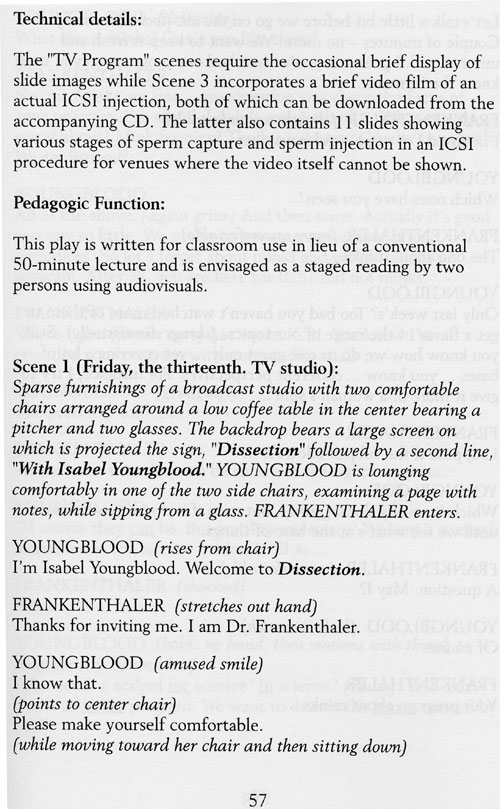
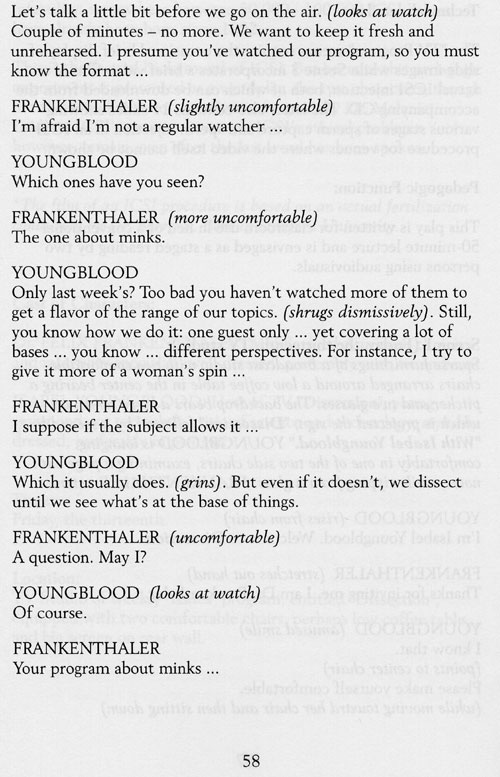
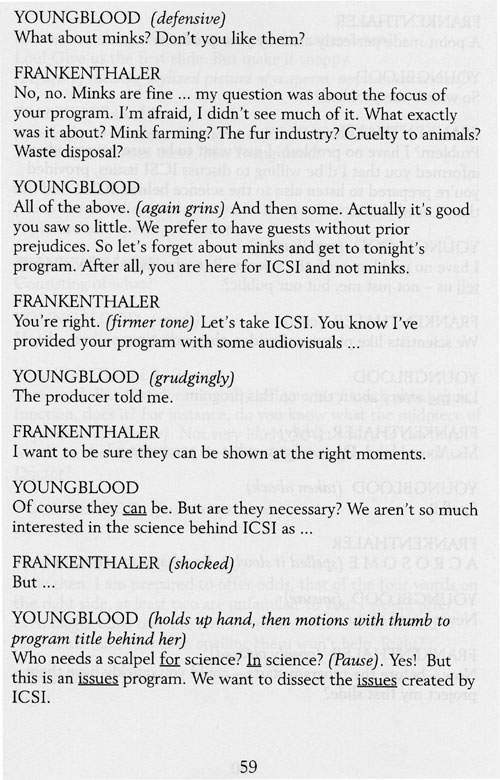
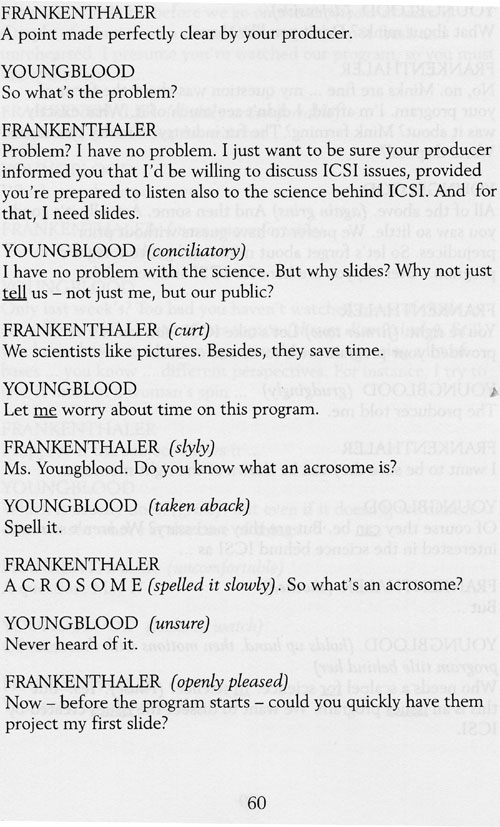
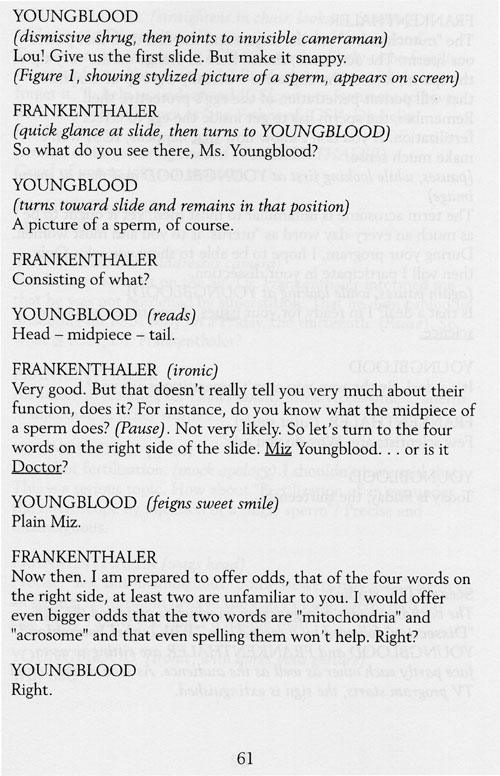
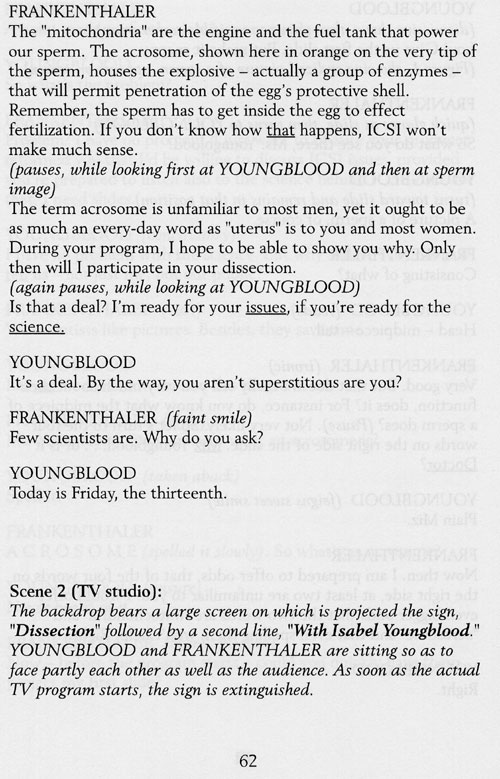
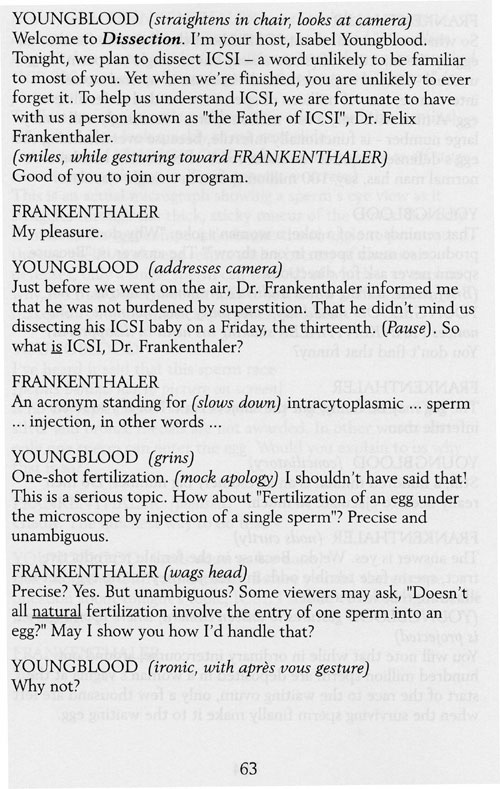
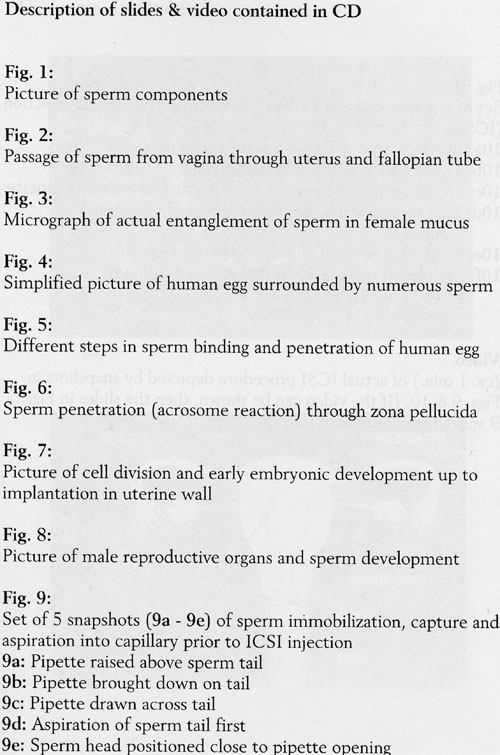
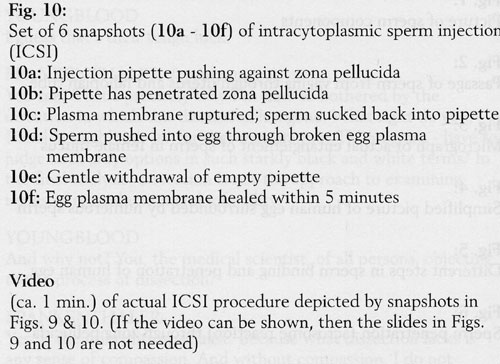
Sample Pages:
Slideshow and movie require quicktime 6 which can be downloaded here